

Bone conduction headphones are a unique type of audio device that transmit sound through vibrations in the skull rather than through the ear canal, allowing users to hear both audio and their surroundings at the same time. Instead of pushing sound waves through the air and into the ear, these headphones rest on the cheekbones or temples and send vibrations directly to the inner ear. As a result, users can stay connected to their environment while still enjoying music, calls, or navigation prompts.
Because of this open-ear design, bone conduction headphones have become increasingly popular among athletes, outdoor workers, and safety-conscious listeners. However, to truly understand their benefits and limitations, it is important to explore how this technology works, how it differs from traditional headphones, and who it is best suited for.
Introduction: Why Bone Conduction Technology Is Gaining Popularity
In recent years, bone conduction headphones have moved from niche medical and military applications into mainstream consumer markets, especially among athletes and outdoor enthusiasts. As urban lifestyles become more active and safety concerns increase, people are looking for audio devices that do not block critical environmental sounds.
At the same time, advances in Bluetooth connectivity, battery efficiency, and transducer design have made bone conduction headphones lighter, more comfortable, and more affordable. Consequently, what was once specialized equipment is now widely available in retail and wholesale markets.
The Shift Toward Open-Ear Listening
As people become more concerned about safety, comfort, and situational awareness, open-ear audio solutions are increasingly preferred over traditional sealed earbuds. For example, runners want to hear approaching vehicles, cyclists need to detect horns, and office workers want to stay alert to conversations.
Moreover, many users dislike the pressure and heat buildup caused by in-ear headphones. Therefore, open-ear designs offer a more breathable and socially acceptable listening experience, especially in shared environments.
Common Misconceptions About Bone Conduction
Many consumers assume that bone conduction headphones are completely risk-free for hearing, but the reality is more nuanced. Although these devices bypass the eardrum, they still stimulate the cochlea, which means excessive volume can still cause hearing damage.
In addition, some people believe bone conduction automatically delivers poor sound quality. While bass response is limited, modern models offer surprisingly clear speech and balanced mids, making them suitable for podcasts, calls, and casual music listening.
What Are Bone Conduction Headphones?
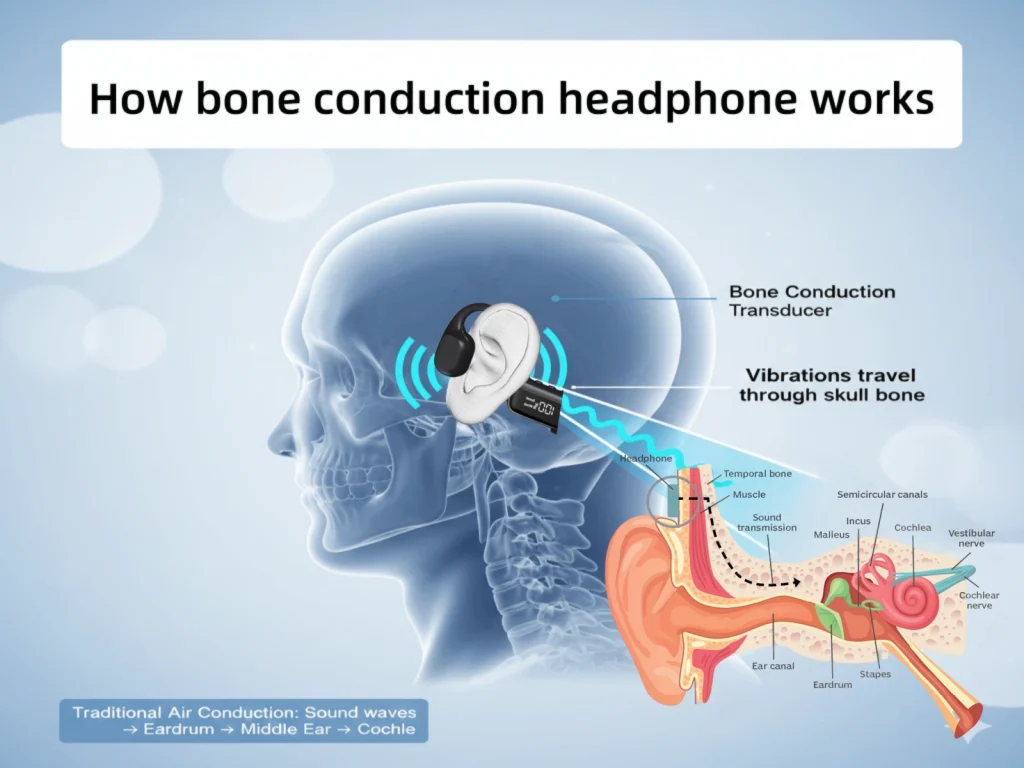
Bone conduction headphones are wearable audio devices that rest on the cheekbones or temples and deliver sound by vibrating the bones of the skull. Instead of sealing the ear canal, they leave it fully open, which allows ambient sounds to mix naturally with the audio being played.
Because of this design, bone conduction headphones are often categorized as open-ear headphones, although not all open-ear headphones use bone conduction technology.
How They Differ From Traditional Headphones
Unlike in-ear or over-ear headphones, bone conduction models do not block or cover the ear canal at all. Traditional headphones rely on air movement to carry sound waves, while bone conduction relies on physical vibration.
As a result, bone conduction headphones do not isolate users from their surroundings. While this reduces immersion, it greatly improves safety and awareness, which is critical in many real-world situations.
Key Components of a Bone Conduction Headset
Although they look simple, bone conduction headphones contain specialized transducers, Bluetooth chips, batteries, and vibration drivers engineered for efficient signal transfer. Each component plays a role in balancing sound clarity, comfort, and power efficiency.
Bone Conduction Transducers
The transducer converts electrical audio signals into mechanical vibrations that can travel through bone tissue. Engineers design these drivers to operate efficiently at frequencies that transmit well through bone, especially in the midrange used for speech.
Because bone is less responsive to low-frequency vibrations, deep bass is difficult to reproduce. Therefore, manufacturers focus on clarity rather than heavy bass output.
Bluetooth and Control Modules
Wireless connectivity and playback controls are handled by compact integrated circuits designed to minimize power consumption. Newer Bluetooth versions improve stability, reduce latency, and allow smoother switching between devices.
In addition, built-in microphones and noise reduction algorithms help improve call quality, which is essential for professional and sports use.
How Bone Conduction Technology Works
To understand bone conduction headphones, it helps to first understand how human hearing normally works. Hearing relies on mechanical vibrations that eventually stimulate sensory cells inside the inner ear.
Normal Air Conduction Hearing Explained
In typical hearing, sound waves travel through the air, enter the ear canal, vibrate the eardrum, and are transmitted through tiny middle-ear bones to the cochlea. The cochlea then converts these vibrations into electrical signals that the brain interprets as sound.
This pathway is known as air conduction and is how most headphones and speakers deliver audio.
The Bone Conduction Pathway
With bone conduction, vibrations bypass the eardrum entirely and travel directly through the skull to stimulate the cochlea. The cheekbones, jaw, and temporal bones all act as transmission paths.
Therefore, even if the ear canal is blocked or damaged, sound can still reach the inner ear using this alternative route.
Why the Cochlea Still Does the Hearing
Even though the sound travels a different path, the cochlea remains the organ that converts vibrations into nerve signals for the brain. This means that hearing safety still depends on how much energy reaches the cochlea, regardless of whether it arrives through air or bone.
Consequently, volume control remains important for long-term hearing health.
Scientific and Medical Origins of Bone Conduction
Bone conduction was first studied in medical research and hearing aids long before it appeared in consumer electronics. Doctors used it to test hearing function and to help patients with conductive hearing loss.
Later, military and rescue teams adopted bone conduction headsets because they allow communication without blocking ambient sounds, which is critical in tactical environments.
Bone Conduction vs Traditional Headphones
While both types of headphones aim to deliver audio, their methods and user experiences are fundamentally different. Choosing between them depends on listening priorities rather than price alone.
Sound Delivery Method Comparison
Traditional headphones rely on air pressure changes, while bone conduction relies on mechanical vibration. Air conduction can produce richer bass and fuller sound, whereas bone conduction prioritizes clarity and safety.
Because of this, bone conduction headphones are rarely marketed for audiophile use, but they perform well for spoken content and casual music.
Comfort and Ear Fatigue
Because they do not enter the ear canal, bone conduction headphones can reduce pressure and moisture buildup in the ears. This makes them more comfortable for long-term wear, especially during exercise or work shifts.
However, some users may feel mild pressure on the cheekbones after extended use, although improved padding and lighter materials have reduced this issue in newer models.
Noise Isolation vs Environmental Awareness
One of the biggest trade-offs is that bone conduction headphones prioritize awareness over immersion. While traditional headphones block noise, bone conduction allows external sounds to remain audible.
This makes them ideal for safety but less suitable for travel or noisy environments where isolation is desired.
Sound Quality and Bass Performance
Due to physical limitations, bone conduction headphones generally cannot match the bass depth of traditional headphones. Vibrations do not transmit low frequencies efficiently through bone.
Nevertheless, digital signal processing helps enhance perceived fullness, and for many users, clarity matters more than bass impact.
Advantages of Bone Conduction Headphones
The growing popularity of bone conduction headphones is largely driven by their unique benefits in safety and comfort. These advantages align well with modern active lifestyles.
Improved Situational Awareness
Users can hear traffic, voices, and warning signals while still enjoying music or navigation prompts. This significantly reduces accident risk during outdoor activities.
As a result, bone conduction headphones are often recommended for runners and cyclists.
Safer for Certain Activities
Activities like cycling, running, and hiking benefit greatly from open-ear audio. Many local regulations also restrict the use of noise-isolating headphones while driving or cycling.
Therefore, bone conduction provides a legal and practical solution in many regions.
Useful for People With Ear Canal Issues
Some individuals who cannot tolerate earbuds due to infections or anatomical differences find bone conduction more comfortable. Since nothing enters the ear canal, irritation and moisture buildup are reduced.
This also benefits people who wear hearing protection or medical devices.
Reduced Ear Pressure and Heat
Without sealed ear tips, airflow around the ear remains natural and cooling. This improves comfort during long workouts and in hot climates.
Consequently, many users report less fatigue compared to in-ear headphones.
Disadvantages and Limitations
Despite their benefits, bone conduction headphones are not ideal for every situation or user. Understanding the limitations helps set realistic expectations.
Lower Audio Fidelity in Noisy Environments
External sounds can easily compete with vibration-based audio, making listening difficult in loud areas. Users may increase volume to compensate, which can reduce hearing safety benefits.
Therefore, bone conduction is not ideal for crowded public transport or industrial noise environments.
Sound Leakage to Others
Because vibrations can radiate outward, nearby people may hear faint audio in quiet spaces. This can be distracting in offices or libraries.
However, newer designs minimize leakage through improved vibration control.
Possible Vibration Discomfort
Some users experience tickling or pressure sensations during long listening sessions. While this usually fades with adaptation, it may bother sensitive users.
Proper fit and moderate volume can reduce discomfort.
Battery and Volume Constraints
Higher vibration levels require more power, which can limit battery life and maximum safe volume. Therefore, bone conduction headphones typically offer shorter playtime than some traditional wireless earbuds.
Are Bone Conduction Headphones Safe for Hearing?
Safety is often cited as a major advantage, but bone conduction headphones are not completely risk-free. Responsible use is still necessary.
Noise-Induced Hearing Loss Still Applies
The cochlea can still be damaged by excessive vibration just as it can by loud air-conducted sound. Therefore, listening at high volume for long periods can still cause hearing loss.
This applies to all headphone types, including bone conduction.
Safe Volume Guidelines
Experts recommend following the same volume-and-time exposure limits used for traditional headphones, such as the 60/60 rule: no more than 60% volume for 60 minutes at a time.
Regular breaks help reduce cumulative exposure.
Benefits for Middle-Ear Conditions
Because they bypass the eardrum, bone conduction devices can help users with certain conductive hearing problems. However, they are not a replacement for medical hearing aids unless designed for that purpose.
Users with hearing conditions should consult professionals before relying on consumer models.
Who Should Consider Using Bone Conduction Headphones?
Bone conduction headphones are not a universal replacement for traditional models, but they are ideal for specific users and scenarios.
Athletes and Outdoor Enthusiasts
Runners, cyclists, and hikers often prioritize safety awareness over immersive sound. Bone conduction allows them to stay alert while following training playlists or GPS directions.
This makes the technology especially attractive in fitness markets.
Office and Remote Workers
Open-ear listening allows users to stay responsive to colleagues and alerts. This improves multitasking and communication in shared spaces.
Additionally, it reduces ear fatigue during long conference calls.
Industrial and Professional Use Cases
Certain work environments require communication and environmental awareness at all times. Bone conduction headsets are widely used in logistics, construction, and emergency services.
They allow clear communication without blocking safety signals.
Common Use Scenarios and Applications
Different listening environments highlight different strengths and weaknesses of bone conduction technology. Choosing the right model depends on how and where it will be used.
Sports and Fitness Training
Sweat resistance and stable fit make bone conduction popular for workouts. Many models include lightweight frames that remain secure during movement.
In addition, physical buttons are easier to operate than touch controls when hands are wet or gloved.
Swimming and Waterproof Models
Some models include built-in storage for underwater listening where Bluetooth cannot function. These are designed for swimmers who want music during laps.
High waterproof ratings such as IPX8 are essential for full submersion.
Phone Calls and Voice Assistants
Microphones and vibration drivers are optimized for clear speech transmission in open environments. This makes bone conduction suitable for hands-free communication and voice commands.
Wind noise reduction further improves outdoor call quality.
Bone Conduction vs Open-Ear Air Conduction Headphones
Not all open-ear headphones use bone conduction, and the difference matters when choosing a device. Both designs aim to preserve awareness, but they use different sound delivery methods.
How Air-Conduction Open-Ear Designs Work
These models direct sound toward the ear without sealing the canal, using small speakers instead of vibration drivers. They sit near the ear opening rather than on the cheekbones.
As a result, they provide more natural sound but still allow ambient noise.
Comfort and Fit Differences
Bone conduction rests on the cheekbones, while air-conduction open-ear models usually sit near the ear opening or hook over the ear. Fit preference varies by user and activity type.
For high-motion sports, bone conduction often provides better stability.
Which Technology Sounds Better?
Air-conduction open-ear designs generally deliver fuller audio, but sacrifice some stability and clarity in noisy areas. Bone conduction offers more consistent performance regardless of ear shape.
Therefore, the choice depends on whether sound quality or secure fit is the top priority.
Key Features to Look for When Buying Bone Conduction Headphones
Choosing the right model requires balancing performance, durability, and comfort. Buyers should evaluate technical specifications as well as real-world usability.
Waterproof Rating and Build Quality
Higher IP ratings are essential for swimming and heavy sweat conditions. Materials should resist corrosion and repeated vibration stress.
This is especially important for sports and industrial users.
Battery Life and Charging Method
Battery capacity affects not only playtime but also long-term device longevity. Magnetic charging ports are common and reduce wear compared to standard connectors.
Fast charging is also a valuable feature for daily use.
Bluetooth Version and Codec Support
Newer Bluetooth versions improve stability and reduce latency. This is important for video playback and phone calls.
Stable connectivity is especially critical in professional environments.
Internal Storage for Offline Playback
Built-in memory allows listening during swimming or in restricted wireless environments. Storage also serves as backup when phone connections are not allowed.
This feature is valuable for training and military applications.
The Future of Bone Conduction Technology
Advancements in materials and signal processing continue to improve vibration efficiency and sound quality. As a result, the technology is expanding beyond headphones.
Improved Transducer Materials
New composites can transmit vibrations more effectively with less power. This leads to clearer sound and longer battery life.
Manufacturers are also reducing device size while improving output.
Integration With Wearable Devices
Smart glasses and helmets are beginning to incorporate bone conduction audio systems. This allows seamless communication without extra accessories.
Such integration is likely to grow in industrial and consumer markets.
Medical and Accessibility Innovations
Bone conduction remains a key technology for specialized hearing assistance devices. Future designs may further blur the line between medical and consumer electronics.
This could improve accessibility for many users worldwide.
Final Thoughts: Choosing the Right Listening Technology for Your Lifestyle
Bone conduction headphones offer a fundamentally different listening experience that prioritizes safety, comfort, and awareness over pure audio fidelity. Instead of replacing traditional headphones, they serve as a complementary option for specific activities and environments.
If your daily routine involves outdoor movement, shared workspaces, or safety-sensitive tasks, bone conduction can provide a practical and reliable solution. However, if immersive sound and deep bass are your top priorities, traditional headphones may still be the better choice.
Ultimately, the best technology is the one that fits your lifestyle, protects your hearing, and supports your daily activities without unnecessary compromise.
FAQ
Do bone conduction headphones work for swimming?
Only models with built-in storage and high waterproof ratings can be used for swimming, since Bluetooth does not work underwater.
Are bone conduction headphones suitable for phone calls?
Yes, most models include microphones and noise reduction features designed for clear voice communication in open environments.