
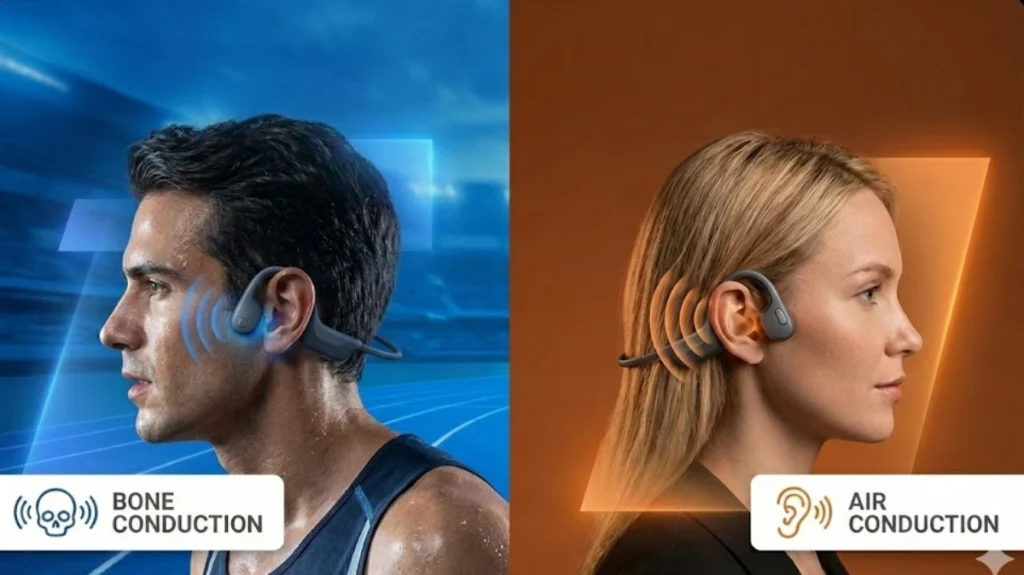
If you’re trying to choose between Bone Conduction vs Air Conduction Headphones, you’re really choosing between two different ways of delivering sound—and two different priorities. Bone conduction sends vibrations through your cheekbones to your inner ear, keeping your ear canal open. Air conduction is the “traditional” approach used by earbuds and headphones, sending sound waves through the air into your ear canal and eardrum.
That difference leads to the core trade-off: bone conduction typically offers better situational awareness and reduced ear-canal pressure, while air conduction usually delivers better sound quality, bass, and immersion, plus stronger isolation (especially with sealed designs and ANC). This guide breaks down how each technology works, what you can realistically expect in audio performance, and which option makes the most sense for sports, commuting, office work, and specific hearing needs.
What Is Bone Conduction vs Air Conduction? How Each Technology Works?
1. Air Conduction: The “Normal” Path Your Ears Are Built For
Air conduction headphones (in-ear, on-ear, and over-ear) use small speakers that push air to create sound waves. Those waves travel into your ear canal, vibrate the eardrum, and then pass through the middle ear to the cochlea (inner ear), where your brain interprets them as sound.
Air conduction includes several familiar form factors:
- In-ear (earbuds/IEMs): Sit inside the ear canal, often creating a seal with silicone or foam tips.
- On-ear: Sit on the outer ear, usually lighter but can press on the ear cartilage.
- Over-ear: Surround the ear, often the most immersive and comfortable for some people, but can trap heat.
- Open-ear air conduction (non-sealing): Hover near the ear canal without plugging it (not bone conduction), aiming to keep awareness while still using air conduction.
Because air conduction follows the ear’s natural pathway, it’s generally better at reproducing a wide range of frequencies—especially low-end bass—with more fidelity and a wider perceived soundstage.
2. Bone Conduction: Vibrations Through Bone, Bypassing the Eardrum
Bone conduction headphones use vibrating transducers (often called exciters) that rest on or near the cheekbones (typically in front of the ears). Instead of pushing air into your ear canal, they transmit vibrations through bone to reach the inner ear, bypassing the eardrum.
That’s why bone conduction is often described as “open ear” by default: the ear canal remains unobstructed, and you can hear more of your surroundings while listening.
A few clarifications that prevent confusion:
- Bone conduction does not mean “silent.” Sound can still leak because the device housing vibrates and can act like a small external speaker.
- Bone conduction doesn’t “turn off” your hearing. You’re mixing audio playback with the real world, which is a feature for safety—but can be a drawback in noisy places.
3. Why the Delivery Method Changes Everything
Because bone conduction relies on vibration transfer and skull conduction rather than air pressure in a sealed ear canal, you’ll usually notice:
- Less bass impact and lower overall musical “fullness”
- High clarity for speech (podcasts, calls, audiobooks)
- More awareness of traffic and conversation
- Lower isolation from environmental noise
On the other hand, air conduction—especially sealed in-ears and closed-back over-ears—can deliver:
- Fuller bass and detail
- Better immersion for music, movies, and gaming
- Better privacy and less leakage (especially closed designs)
- Stronger noise isolation, often enhanced by ANC
Sound Quality Comparison: Bass, Clarity, Volume, and Audio Leakage
Sound is often the deciding factor, so let’s break it down into the parts you actually notice day-to-day.
1. Bass: The Most Obvious Difference
If you listen to hip-hop, EDM, cinematic scores, or any genre where sub-bass matters, air conduction wins almost every time.
- Air conduction (sealed earbuds or closed-back over-ear) can create pressure in the ear canal that supports deep bass reproduction.
- Bone conduction transducers can’t move air in the same way, and vibration-based transfer has physical limits—so bass often feels lighter and less “punchy.”
Reality check: Bone conduction has improved a lot, but if “bass slam” is your priority, you’ll likely feel underwhelmed.
2. Clarity and Detail: Speech vs Music
Bone conduction is frequently described as “clear enough” for voice content. That’s because the midrange—where speech intelligibility lives—can come through well even if deep bass is limited.
- Great for: podcasts, audiobooks, calls, navigation prompts
- Mixed for: music with layered instrumentation, complex mixes, or tracks that rely on wide dynamics
Air conduction generally offers better overall fidelity: cleaner treble extension, more separation between instruments, and a wider soundstage (especially with well-tuned over-ear headphones).
3. Maximum Volume and Noisy Environments
In quiet or moderately noisy spaces, both can work well. But in loud environments (busy streets, trains, gyms), the experience diverges:
- Air conduction (sealed + ANC): Often best for loud commutes because it blocks noise and keeps volume needs lower.
- Bone conduction: Since you still hear the environment clearly, you may be tempted to raise volume to compete with background noise—at which point you may also notice stronger vibration sensation and more leakage.
If you routinely listen in loud environments and want to protect your hearing, a well-sealed air conduction model (possibly with ANC) can reduce the urge to crank the volume.
4. Sound Leakage: Who Around You Can Hear It?
Sound leakage depends on design, but general patterns hold:
- Bone conduction: Leakage can be noticeable at higher volumes because the vibrating housing produces audible sound externally.
- Air conduction:
- Closed-back over-ear and well-sealed in-ear: typically leak the least
- Open-back over-ear and open-ear air conduction: leak more by design
If you share an office, sit in a quiet library, or commute on a silent train car, a closed or sealed air conduction option is usually the safest for privacy.
5. Noise Isolation: The “Open Ear” Trade-off
Bone conduction is inherently low-isolation—your ears are open, and that’s the point.
Air conduction ranges from low to excellent isolation depending on the product:
- Best isolation: sealed in-ear + ANC, closed-back over-ear + ANC
- Moderate isolation: well-fitting in-ear without ANC
- Low isolation: open-back over-ear, open-ear air conduction
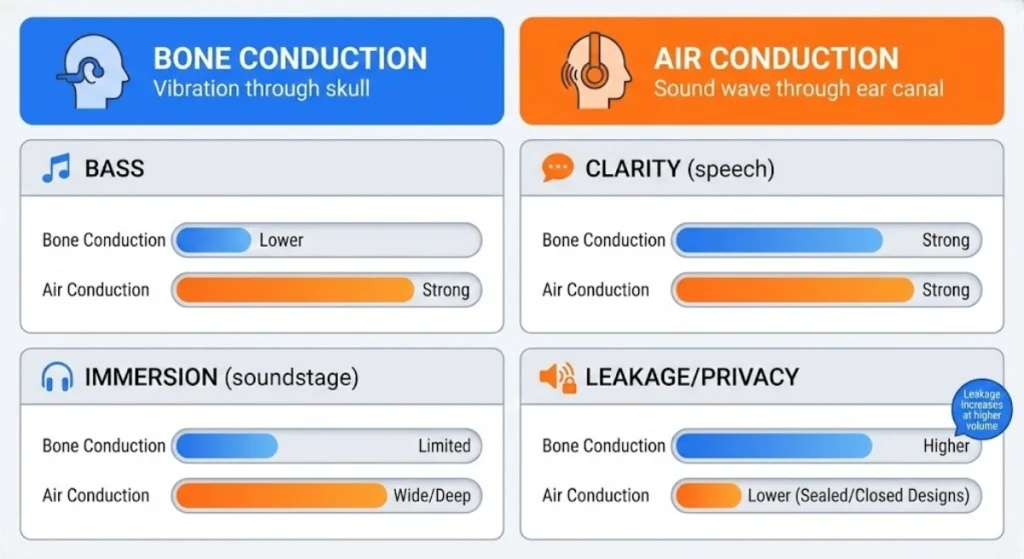
6. Quick Comparison Table: Sound & Privacy
| Factor | Bone Conduction | Air Conduction (In-ear / On-ear / Over-ear) |
|---|---|---|
| Bass | Usually weaker due to vibration limits | Typically fuller, deeper bass (especially sealed/closed) |
| Clarity for speech | Often very good | Very good to excellent |
| Music fidelity & soundstage | Moderate; less immersive | Usually superior; best for music, movies, gaming |
| Performance in loud places | Harder without isolation | Strong with seal + (optional) ANC |
| Noise isolation | Minimal | Ranges from low (open) to excellent (sealed/closed) |
| Sound leakage | Can be noticeable at high volume | Lowest with sealed/closed; higher with open designs |
Comfort, Safety, Use Cases, and other Features
1. Comfort & Fit: Ear Canal Pressure vs “Nothing in the Ear”
Comfort is personal, but each technology has predictable strengths.
Bone conduction comfort advantages:
- Nothing inserted into the ear canal → less “plugged” feeling
- Reduced risk of ear-canal irritation for people sensitive to ear tips
- Often stable wraparound designs for running/cycling
Potential comfort downsides:
- Some people feel pressure where the transducers contact the cheekbones
- At higher volumes, vibration sensation can be distracting
- Glasses, helmets, and masks can affect fit depending on frame design
Air conduction comfort advantages:
- Huge variety of ergonomics (light earbuds, cushy over-ears, etc.)
- Over-ear models can be comfortable for long desk sessions (with breathable pads)
- Many options for calls and conferencing
Potential comfort downsides:
- In-ear: tip pressure, ear-canal fatigue, irritation for some users
- Over-ear: heat buildup, clamping force, hair/glasses interactions
- On-ear: cartilage pressure over time
2. Safety & Situational Awareness: When “Open Ear” Matters
For outdoor movement, hearing what’s around you can be more than convenience—it can be safety-critical.
Bone conduction keeps the ears open, making it popular for:
- Running and walking near traffic
- Cycling (where hearing vehicles and warnings matters)
- Outdoor work sites where awareness is required
Air conduction can be either:
- Blocking (sealed in-ear, closed over-ear) which reduces awareness
- Partially open (open-ear air conduction, transparency modes) which helps—but may not match the natural openness of bone conduction in every real-world situation
Important nuance: Transparency modes are helpful, but they rely on microphones and processing. Wind noise, sudden loud sounds, and imperfect tuning can reduce how “natural” awareness feels.
3. Use Case Matchups
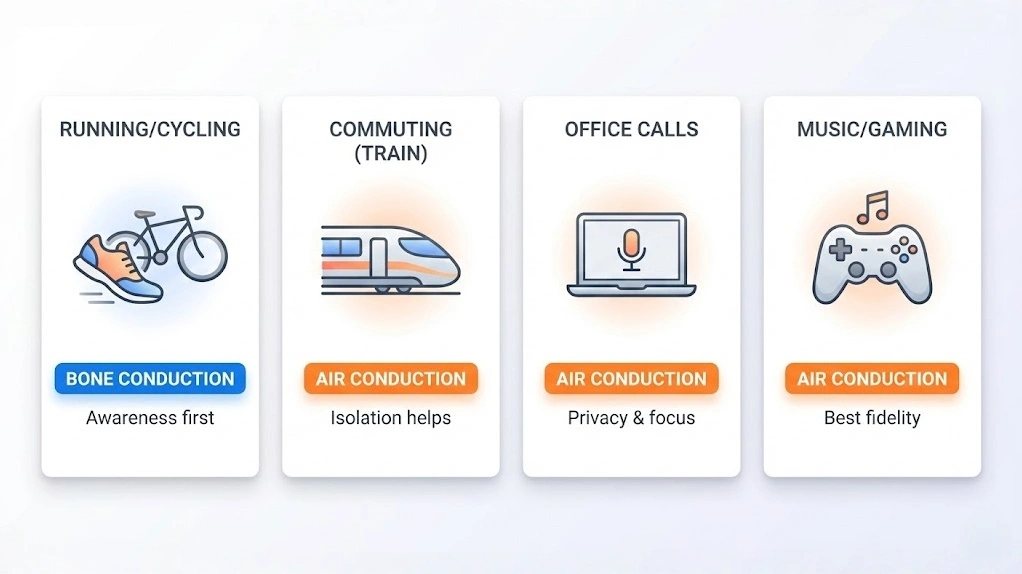
Sports: Running, Cycling, Gym
- Best fit: Bone conduction (or open-ear air conduction) for outdoor running/cycling
- Why: awareness + stable fit + less ear-canal sweat buildup
- Gym note: In a loud gym, sealed air conduction earbuds may work better because isolation helps you keep volume lower.
Commuting: Trains, Subways, Busy Streets
- Best fit: Air conduction with a good seal; ANC if you like quiet
- Why: noise isolation improves clarity and reduces the urge to increase volume
- Alternative: Bone conduction if you prioritize hearing announcements, navigating streets, or staying alert—just be aware that loud transit noise can overpower your audio.
Office & Remote Work: Calls, Focus, and Comfort
- Best fit (privacy + focus): Air conduction closed-back or sealed in-ear
- Best fit (awareness + comfort): Bone conduction if you need to hear colleagues or don’t like ear tips
- Leakage reality: Bone conduction can leak at high volumes, so keep it moderate in shared spaces.
Gaming & Movies: Immersion and Spatial Audio
- Best fit: Air conduction (often over-ear)
- Why: better bass, imaging, and immersion; less external noise interference
4. Health & Accessibility: Hearing Needs and Ear Sensitivity
Bone conduction can be useful for some people with conductive hearing loss (where the issue involves the outer/middle ear), because it bypasses the eardrum pathway. It may also reduce irritation for those prone to ear-canal discomfort.
However:
- If someone has significant sensorineural hearing loss, bone conduction may not solve the core issue, and professional guidance from an audiologist is recommended.
- Regardless of headphone type, listening too loud for too long can contribute to hearing damage. Open-ear designs can make users turn volume up in noisy places—so be mindful.
5. Durability, Sweat Resistance, and Water Use
A common pattern in the market is that bone conduction models are often designed with sports in mind, so you’ll frequently see higher sweat resistance. That said:
- Not all bone conduction headphones are waterproof, and “waterproof” ratings vary widely (splash-proof vs submersible).
- Air conduction can also be sweat- and water-resistant, especially sports earbuds.
- For swimming or heavy water exposure, you must check the actual IP rating and the manufacturer’s stated use case (and whether Bluetooth works underwater—often it doesn’t).
6. Battery Life: Why It Can Differ
In general:
- Bone conduction can have shorter battery life because vibration-based transducers can be power-hungry, and many models prioritize light weight.
- Air conduction ranges widely—over-ear headphones often fit larger batteries and can last longer, while tiny earbuds may be comparable to bone conduction depending on features like ANC.
Which Should You Choose? Pros/Cons and Top Recommendations by Scenario
1. Pros and Cons Summary
Bone Conduction — Pros
- Excellent situational awareness (ears stay open)
- No ear-canal pressure; often comfortable for long wear
- Strong for speech content and calls
- Popular for outdoor sports and commuting where awareness matters
- Can be helpful for some conductive hearing-loss scenarios (case-dependent)
Bone Conduction — Cons
- Typically weaker bass and less musical immersion
- Minimal noise isolation; harder in loud places
- Sound leakage can be noticeable at higher volumes
- Fit can interact with glasses/helmets; cheekbone pressure varies by person
- Often priced mid-to-high due to specialized design and components
Air Conduction — Pros
- Best overall sound quality and bass potential
- Wide variety of designs and price points
- Strong isolation options; ANC available
- Better privacy with sealed/closed designs
- Best for music, gaming, movies, studio-style listening
Air Conduction — Cons
- Sealed designs can reduce awareness (safety trade-off outdoors)
- In-ear/over-ear fatigue possible for long sessions (pressure/heat)
- Fit quality varies; poor seal hurts bass and noise isolation
- Some people experience ear irritation with tips or sweat buildup
2. Top Recommendations by Scenario (Technology Choice, Not Brand-Specific)
| Scenario | Best Pick | Why |
|---|---|---|
| City running / cycling | Bone conduction (or open-ear air) | Maximum awareness of traffic and people |
| Quiet office focus | Air conduction (closed/sealed) | Low leakage + better concentration |
| Calls + multitasking at home | Either (depends on preference) | Bone for comfort/awareness; air for voice isolation |
| Noisy commute (subway/train) | Air conduction with seal + optional ANC | Isolation reduces volume needs and improves clarity |
| Music-first listening | Air conduction | Better bass, detail, and immersion |
| Sensitive ear canals / dislike ear tips | Bone conduction | Nothing inserted; less irritation for many users |
| Shared workspace privacy | Air conduction (closed/sealed) | Usually least leakage |
| Outdoor work requiring awareness | Bone conduction | Hear surroundings while staying connected |
Final Comparison Verdict
Bone Conduction vs Air Conduction Headphones represents a function-driven choice, not a quality hierarchy. Bone conduction prioritizes safety and accessibility. Air conduction prioritizes fidelity and immersion. Selection depends on environment, hearing needs, and listening goals.
FAQ
Are bone conduction headphones safer than air conduction headphones?
They can be safer in terms of situational awareness because your ears stay open, which helps you hear traffic and people nearby. But hearing safety still depends on volume and duration—either type can be harmful if played too loud for too long.
Why do bone conduction headphones have less bass?
Bass reproduction usually relies on moving air and creating pressure changes in (or around) the ear canal. Bone conduction transmits vibrations through bone, which has physical limits for deep low-frequency impact compared with sealed air conduction designs.
Do bone conduction headphones leak sound?
Yes. While the ear canal stays open, the vibrating transducers and housing can produce audible sound externally—especially at higher volumes. Leakage levels vary by model and fit.
Are “open-ear” air conduction headphones the same as bone conduction?
No. Open-ear air conduction designs still use speakers that send sound through the air (not through bone). They aim to keep the ear canal open like bone conduction, but the sound delivery method is different.
Which is better for commuting: bone conduction or air conduction?
If your commute is loud (train/subway), air conduction with a good seal (and optionally ANC) often performs better. If you prioritize hearing announcements and staying aware while walking streets, bone conduction can be more practical.
Can bone conduction help with hearing loss?
It can help in some conductive hearing loss cases because it bypasses the eardrum pathway. For significant or complex hearing loss (especially sensorineural), an audiologist should advise on the best solution.